Root Canal Treatment

    Endodontics - Root Canal Treatment

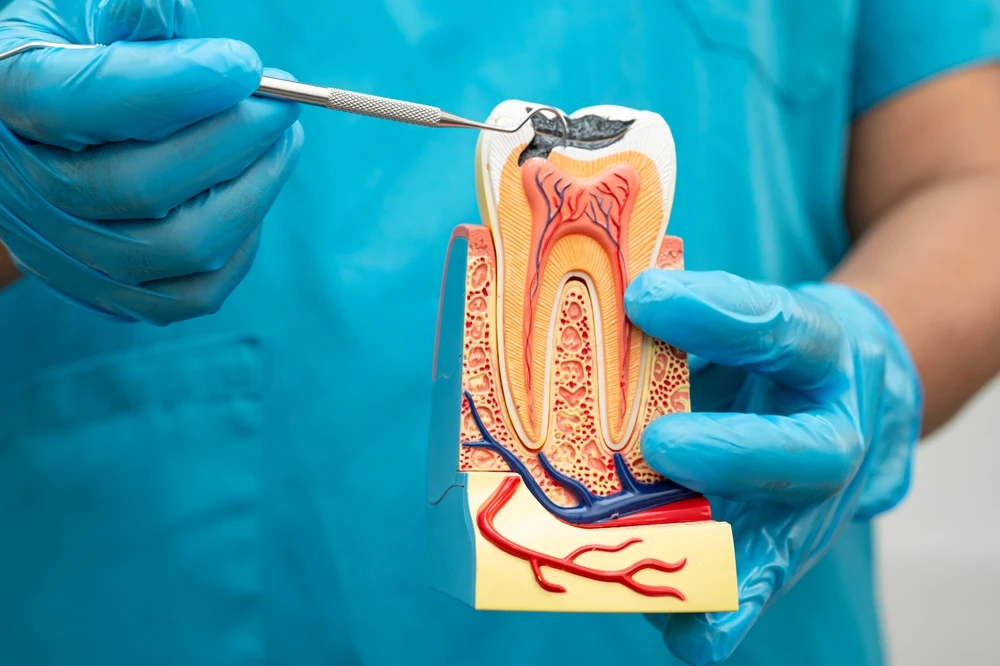
    When the pulp is irreversibly affected by causes such as advanced tooth decay or trauma, it often needs to be removed from the root canals. The canals are then shaped and filled.

    Root canal treatment can be completed in a single appointment, after which an appropriate temporary filling is placed. At the next appointment, the tooth is restored with a filling, onlay, or crown, as appropriate. In some cases, however, after the remaining pulp tissue has been removed, medication may be placed inside the canals and left there for a period of time to allow the tissues to heal. Additional appointments may be necessary to replace the medication. In such cases, completion of the root canal treatment may take several appointments.

    Pulp Amputation

    In some cases where the pulp is affected, it is not necessary to remove the pulp throughout the root canals. Instead, only the portion of the pulp within the pulp chamber, up to the canal entrances, is removed and the chamber is then filled. This minimally invasive approach was largely abandoned for a period of time but has regained a place in modern dentistry thanks to advances in dental materials and scientific research.

    Frequently Asked Questions

    Healthy root canal-treated teeth, when restored with treatments that do not allow microleakage, can function for many years just like untreated teeth. They also feel the same during chewing. The only difference is that they do not sense hot and cold.

    During root canal treatment, the nerves inside the tooth are removed and the emptied space is filled with root canal filling material. However, the connection between the root and the surrounding bone remains alive. You continue to feel even the slightest thing that touches your tooth, just as you do with your natural teeth. The only thing you do not experience is sensitivity to hot and cold. If a root canal-treated tooth develops decay, it does not cause pain and may not show symptoms until it fractures or becomes infected. Therefore, regular dental check-ups are important.

    Your natural tooth is always the preferred option whenever it can be saved and provide a more comfortable sense of feeling. If the tooth requiring root canal treatment is very weak and has a high likelihood of fracture, or if it is infected and has an anatomy that prevents a good root canal treatment, then avoiding the risk and extracting the tooth may be an alternative. It is more appropriate to think of implant treatment not as an alternative to a natural tooth, but as an alternative for the treatment of tooth loss.